Draft Mode: Why the Sketch Is Beating the Masterpiece
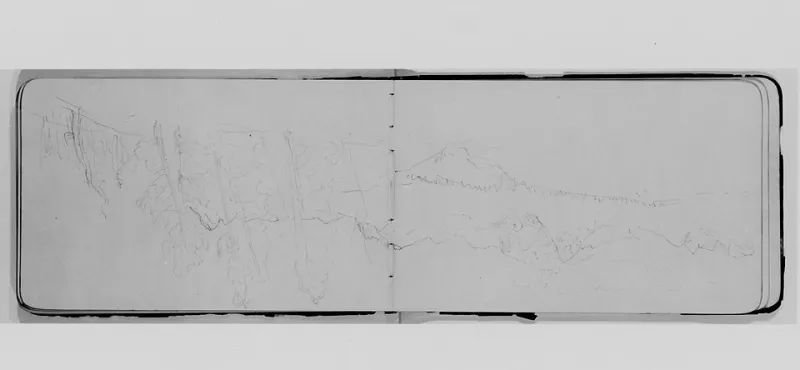
Photo: Albert Bierstadt, CC0, via Wikimedia Commons
There's a particular kind of video that keeps showing up everywhere right now. An artist's hand moving across a half-finished canvas. A producer looping a beat that clearly isn't done yet. A graphic designer narrating their screen while they second-guess a font choice out loud. None of it is polished. None of it is finished. And somehow, none of it can be scrolled past.
We're living through a quiet but real shift in how creative work gets valued — and it's flipping the traditional script on its head. The pristine final product used to be the point. Now, increasingly, the messy middle is stealing the show.
The Curtain Was Always a Lie
For most of art history, the process was kept private. You didn't show people the crumpled drafts, the abandoned color studies, the seventeen versions of a logo that didn't work. You showed them the thing when it was ready. The curtain was part of the mystique.
But that curtain was also, in a lot of ways, a performance of its own. It created a clean fiction: that great work arrives fully formed, that masters don't struggle, that the distance between idea and execution is effortless for the talented few. Anyone who has actually made something knows that's nonsense. The struggle is the whole story.
What's changed isn't that creators are suddenly struggling more. It's that they've stopped pretending they aren't.
Process as the Product
Take what's happening in music. Artists like Finneas, who produces a lot of his work from a bedroom setup, have leaned into showing the scaffolding — the raw sessions, the weird experiments, the moments where a track sounds genuinely bad before it sounds good. On the visual art side, illustrators and painters on platforms like TikTok and YouTube are racking up millions of views not with finished pieces but with time-lapses and real-time walkthroughs of work that's still very much in progress.
Design is doing the same thing. Branding studios and independent designers are posting their initial sketches, their mood boards, their "this direction didn't work" moments. It's not just content strategy. For a lot of these creators, the process documentation has become as considered and intentional as the final deliverable.
The unfinished work isn't filler between the real stuff. It is the real stuff.
Why Audiences Are Hooked
Part of this comes down to trust. In an era where everything online can be filtered, AI-generated, or strategically curated to within an inch of its life, watching someone genuinely figure something out in real time feels almost radical. The rough edges are proof of humanity. They signal: this came from an actual person, with actual doubts, working through an actual problem.
There's also something about access. For a long time, the inner workings of creative practice were reserved for art school classrooms or expensive workshops. Now, watching a designer rethink their grid system or a painter scrape back a layer they hate is free, immediate, and available at midnight on your phone. The process has been democratized in a way the finished product never quite was.
And then there's the emotional pull. A completed painting is impressive. Watching someone push through the ugly middle phase of that same painting — the part where it looks worse than when they started — and come out the other side? That's a story. That's the part people actually connect with.
Redefining "Done"
All of this is putting some pressure on a concept that used to feel pretty straightforward: what does it mean for a piece of work to be finished?
In traditional creative fields, "done" was clear. The album got mastered and released. The painting got framed and hung. The logo got delivered and deployed. There was a hard line between the private process and the public product.
But when the sketch gets more engagement than the final illustration, when the rough demo resonates more than the produced track, when the behind-the-scenes video outperforms the campaign it was documenting — the line starts to blur. Creators are beginning to treat their process as a body of work in its own right, with its own value and its own audience.
Some are going further and intentionally leaving work unresolved. Not because they ran out of time, but because the unresolved state is the honest state. Because "done" can sometimes be a kind of lie — a smoothing over of the tension and uncertainty that made the work interesting in the first place.
The Risk in the Rawness
It's worth being honest about the tension here, though. Not every creator sharing their process is doing it from a place of genuine openness. The "authentic behind-the-scenes" moment has become its own kind of content genre, with its own conventions and its own performance. Showing your sketchbook can be just as calculated as hiding it.
There's also a real question about sustainability. If audiences fall in love with the process, does that create pressure to always be in process? To never actually finish anything, because the draft is what gets the clicks? That's a weird trap to build for yourself.
And for some creators, particularly those from communities that have historically had to work twice as hard to be taken seriously, the "show your rough work" ethos doesn't land the same way. The polished final product was hard-won. Asking everyone to lead with imperfection isn't equally easy or equally safe.
What This Actually Means for Creative Culture
Despite those complications, the broader shift feels significant and, mostly, good. It's loosening up a creative culture that got a little too obsessed with the flawless reveal. It's making space for people to value effort and curiosity over perfection. It's reminding everyone — creators and audiences alike — that the interesting part of making something is almost always the part where you don't know how it's going to turn out.
The sketch, the draft, the failed experiment, the 2 a.m. version that almost worked — these aren't the leftovers from the creative process. Increasingly, they're the creative process. And people are starting to treat them that way.
Maybe the masterpiece was always a little overrated. Maybe the thing worth paying attention to was always the work in progress — the part where someone is genuinely, visibly, trying to figure it out.
That part, it turns out, is pretty hard to look away from.